
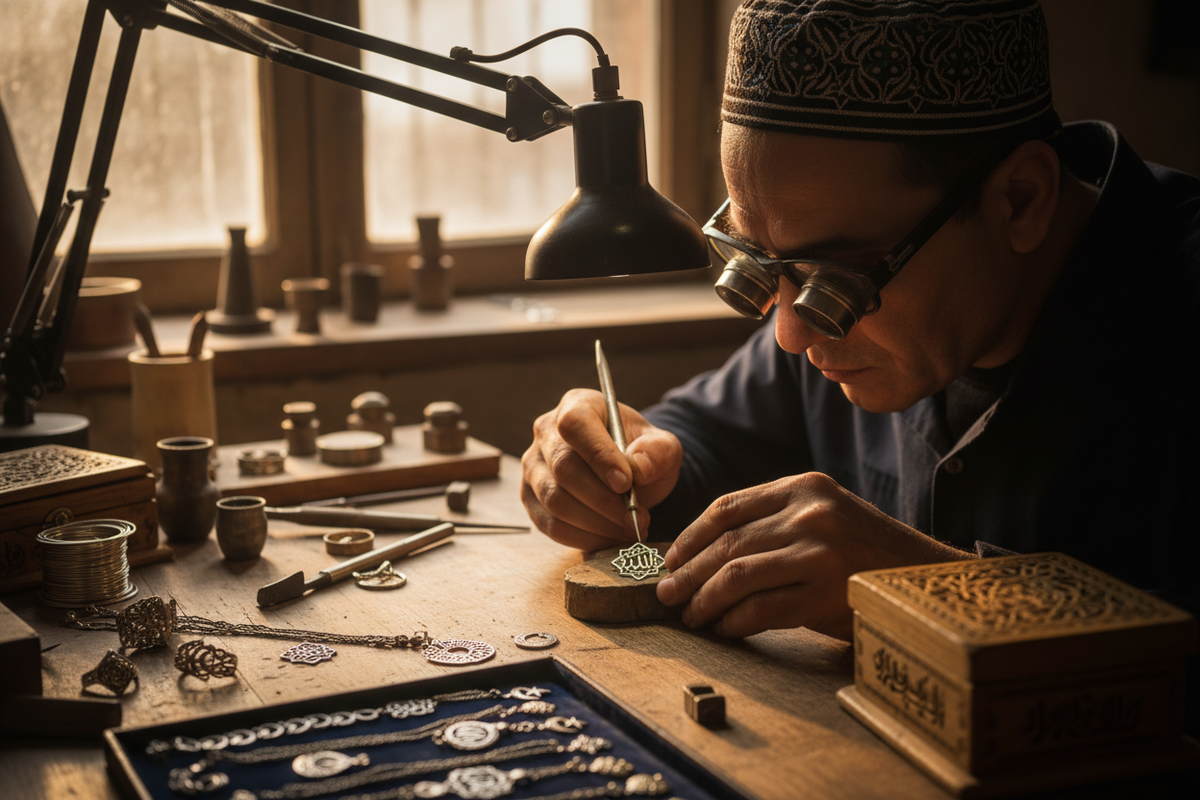
The history of Islamic goldsmithing
Islamic Goldsmithing
From Baghdad to Córdoba, the age-old art of precious metal in Muslim civilization
Islamic goldsmithing is one of the high points of the world's decorative arts. For more than thirteen centuries, artisans, artists and scholars developed a visual language of incomparable complexity and beauty, engraving the signs of a flourishing civilization onto gold, silver and bronze.
From Samarkand to Seville, from Cairo to Constantinople, Islamic workshops produced works that still challenge technical understanding today: ewers with interlaced patterns, basins inlaid with silver and gold, incense burners with geometric interlace of mathematical precision. These objects were not mere ornaments; they carried cosmological knowledge, a faith and a worldview.
This article takes you on a thorough journey through the techniques, production centers, patron dynasties and masterpieces that make Islamic goldsmithing a priceless heritage, and a subject that fascinates more and more collectors, researchers and art lovers.
At the Roots of a Universal Art
Islamic goldsmithing did not appear out of nowhere. It inherited a threefold tradition: Sassanid (pre-Islamic Persia), Byzantine and late Hellenistic. From the 7th century, the Arab conquests created a vast zone of cultural contact that enriched the emerging workshops.
Artisans of the early Abbasid caliphate (750–1258) had silver mines in Iraq and Persia and benefited from trade routes bringing sub-Saharan gold to the Near East. The city of Baghdad, founded in 762 by the caliph al-Mansur, quickly became a center for commissioning and distributing metalwork of extraordinary luxury.
The golden age: 8th to 13th century
This period saw the great innovations. Rival dynasties (the Fatimids in Egypt, the Samanids and Buyids in Persia, the Umayyads of Spain) competed for prestige, with precious metal objects serving as diplomatic ambassadors. The technique of inlay (intarsia), inserting silver or gold wire into bronze, reached unprecedented virtuosity in the workshops of Khorasan.
Continuity and renewal: 13th–16th century
The Mongol conquest of 1258 devastated Baghdad but shifted, rather than destroyed, the creative energy toward Mamluk Syria (Damascus, Cairo), Ilkhanid Persia then Timurid Persia, and soon Ottoman Anatolia. The 14th century saw the flourishing of the great silver-inlaid brass basins that now grace the world's most prestigious museums.
The Grammar of Precious Metal
Islamic goldsmithing stands out for the diversity and sophistication of its techniques. Far from being mere decorators, artisans mastered a true chemistry of alloys, a geometry of forms and a semiotics of motifs. Here are the main techniques that define this exceptional body of work.
Damascening
The art of inlaying gold or silver wire into a less precious metal surface (bronze, iron, steel). The term comes from Damascus, one of the major centers of the practice. The artisan carves grooves with a tool, hammers the precious wire into them, then polishes the surface until the materials blend seamlessly.
Filigree
A technique of extreme delicacy: very fine gold or silver wires are twisted, coiled and soldered to form openwork, lace-like patterns. Common in Fatimid, Andalusian and Ottoman goldsmithing, it reached its peak in the Nasrid jewelry of Granada and the pieces of the Safavid court.
Niello
A dark alloy (lead, copper, silver and sulfur) poured into engravings to create a striking contrast with the polished metal. A technique inherited from Antiquity and elevated by Seljuk and Mamluk workshops. It gives Quranic inscriptions in thuluth calligraphy a dramatic relief.
Cloisonné enamel
Metal partitions are soldered onto a surface and filled with colored glass powders, then fired in a kiln. Islamic enameled goldsmithing, especially in Norman-Arab Sicily and Umayyad Spain, engaged in dialogue with Byzantium while developing its own color codes.
Repoussé & Chasing
Repoussé means working the metal into relief by hammering from the back; chasing refines the details from the front. These complementary techniques make it possible to sculpt narrative scenes, arabesques and inscriptions of striking relief from sheet metal.
Mercury gilding
A gilding process using an amalgam: a gold-mercury alloy is applied to bronze or copper, then heated to vaporize the mercury and fix the gold. An ancient technique, widespread in medieval Islamic goldsmithing. Now banned for its toxicity, it gave pieces a shine that has lasted for centuries.
"For Islamic goldsmiths, metal is never mere material: it is the page on which a vision of the world is written."
After Oleg Grabar, The Formation of Islamic ArtThe motifs: a coded language
Beyond technique, Islamic goldsmithing is recognizable by its ornamental repertoire. Three main registers coexist and intertwine on metal surfaces:
The arabesque: this generic term refers to endlessly branching plant interlace that covers surfaces without ever exhausting them. It symbolizes the infinity of divine creation: no gaze can grasp where it ends. Goldsmiths drew it with a drypoint before gilding or inlay.
Geometry: six-, eight- and twelve-pointed stars, nested polygons, networks of rosettes. Islamic geometry is not gratuitous ornament but cosmological reflection. On a 14th-century Mamluk basin, geometric interlace can reach a precision that astonishes modern mathematicians.
Calligraphy: the queen of Islamic arts, writing covers precious objects. In thuluth, naskhi and floriated Kufic, Quranic verses, blessing formulas (barakah) and princely titles encircle the pieces like declarations of identity and faith. Reading a Mamluk basin means deciphering a dynastic poem.
The Major Production Centers
The Islamic world stretches from Morocco to Central Asia, and its goldsmithing reflects this vast geography through remarkable stylistic diversity. Each center developed its own specialties, alloys and ornaments.
Cradle of inlaid bronze from the 12th century. The ewers and candlesticks of Herat are among the absolute peaks of Islamic art. Workshop signatures include that of Maḥmūd ibn Muḥammad.
Between 1220 and 1260, Mosul produced a series of silver-inlaid bronzes of unmatched quality: royal hunting scenes and astronomical processions that still fascinate art historians.
Mamluk workshops of the 13th–15th century. Heraldic basins, ewers with sultanic inscriptions, monumental candelabra. Calligraphy takes on paramount importance here.
Umayyad Córdoba then Nasrid Granada: gold filigree, garnet jewelry, ivory caskets with metal fittings. Andalusian goldsmithing had a lasting influence on medieval Europe and Mediterranean jewelry.
10th–12th century. Extreme refinement of filigree and a figurative repertoire (birds, lions, musicians) exceptional in the Islamic world. The treasures of Cairo rivaled those of Byzantium.
16th–19th century. The imperial workshops (ehl-i hiref) produced court objects of unrivaled splendor: gold coffee cups set with rubies and emeralds, ornamental helmets, para-liturgical jewelry.
These centers did not work in isolation: the migration of artisans after the Mongol and then Timurid conquests created flows of styles and techniques that sometimes make it hard to attribute a work to a precise place. This is one of the passions, and challenges, of research in Islamic art.
The Pieces That Made History
The Baptistère de Saint Louis
Kept at the Louvre (Department of Islamic Art), this brass basin inlaid with silver and gold, attributed to the workshop of Muḥammad ibn al-Zayn (around 1300, Mamluk Syria or Egypt), is considered one of the most sophisticated works of all medieval art. Horsemen, musicians, predators and sultanic inscriptions in thuluth run across its surface. Its name comes from an unproven tradition that it was used for the baptism of a royal child of Saint Louis's line. True or not, it shows the prestige Islamic goldsmiths enjoyed at Christian courts.
The Blacas Ewer
Dated 629 AH (1232) and attributed to the Mosul workshop of Shujāʿ ibn Manʿa, this silver-inlaid bronze ewer (British Museum, London) is a showcase of Mosul technique at its peak. Its medallions with figures surrounded by foliate scrolls and its calligraphic cartouches make it an absolute reference in the specialist literature.
The candelabrum of the Great Mosque of Kairouan
An extremely rare piece from the 9th century, this gilded bronze candlestick is one of the oldest surviving Islamic liturgical objects. Its pierced conical structure foreshadows the great mosque lamps of the Mamluk period and illustrates the technical continuity between pre-Islamic North African craft and early Islamic production.
The Nasrid caskets of Granada
Made between the 13th and 15th century in the court workshops of the Alhambra, these wood and ivory caskets inlaid with silvered metal illustrate the particular preciousness of late Andalusian goldsmithing. Their silver filigree panels, adorned with eight-pointed stars and Arabic cartouches, are among the peaks of Nasrid taste.
"In every inlay, every silver wire set into bronze, a master craftsman drew a line between craft and the high philosophy of matter."
Ernst Grube, historian of Islamic artEssential Museum Collections
Islamic goldsmithing is now held in the world's greatest museums. Here are the reference collections for anyone wanting to explore further:
The Museum of the Institut du Monde Arabe in Paris and the Musée des Arts Décoratifs also hold important pieces, often less known to the general public but accessible to researchers by appointment.
Everything You Wanted to Know
A collector or a researcher?
Whether you're an enthusiast, a collector or a historian, we're happy to share our passion for Islamic goldsmithing and answer your questions.

Written by Hassan Tigzirt